
Thursday, February 7, 2013
Winter break is over.
I took a break from painting over the winter, since the humidity prevents any spraying of primer or sealer, and I dislike having finished models lying around waiting.
So, goals for 2013:
Finish my Tau up to 2500 points. I can field 2500 right now, but it's not optimized.
Finish my Space Marine battle box.
Finish my Khador up to 35 points. I'm at 30, with about 20 points worth painted and finished.
Finish my Space Hulk, 3rd edition models.
Start my Pan-Oceania starter squad.
And, hopefully, finish my Cityboard project.
Quite a list. We'll see how it goes.


Monday, January 14, 2013
Warmachine
Been a while. I've gotten into Warmachine during 2012, and thought I'd post my impressions.
First, for my first faction, I decided on Khador. I usually go for a more "fiddly" army, like the Tau, but I wanted a straightforward army for Warmachine, and Khador are pretty straightforward. Big, tough, smashy. I started with, appropriately enough, the starter box, and used Prime Sorscha as my warcaster.
 I am not fond of Privateer Press resins. At least, the starter box ones. The flash and cleanup on the Khador Warjacks was time consuming, and never got to a point where I was happy. Cleaning a mould line over a rivet is a bitch and a half. I got them to the point where I could live with it.
Snow, I decided to do snow bases with bits of battlefield debris sticking out. Sometimes this worked great, and sometimes it was just eh. I got a small packet of watch parts to dress the bases as bits of wrecked Warjacks, and glued them to the base so that they would stick out of the snow.
The actual stuff I used for snow was simply baking soda. DO NOT USE BAKING POWDER. It's easy to get the two mixed up if you're not familiar with them.
The effect was fine, but I really would like to try a proper snow effect next time, as the baking soda seemed to yellow a bit after applying the sealer.

 The game itself I really like. I like how colorful the Warcaster characters are, and that every unit has a distinctive ability. The armies tend to be smaller than 40k, and thus it's a bit easier to collect. It helps that the group I joined was just starting an escalation league, and so we started out with very small point value games, and worked up from there over the course of a few months.


Monday, April 4, 2011

Sunday, March 27, 2011
Catching up
Recent work and stuff that I haven't posted yet.
Imperial Fists scouts


Some figures for Dark Sun.


The first minis I ever painted. GW original beakies.

Space Hulk 3-D board.

Tau Pathfinders

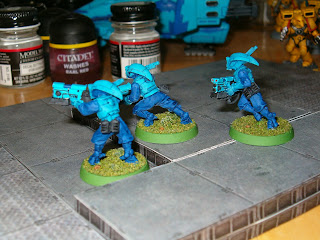
Imperial Fists scouts


Some figures for Dark Sun.


The first minis I ever painted. GW original beakies.

Space Hulk 3-D board.

Tau Pathfinders


Thursday, March 24, 2011
Priming with gesso.
I read about this alternative, and am a convert. Painting in the Seattle area means high humidity for long periods of the year. And humidity makes spraying problematic.
I got a bottle of acrylic gesso from the art department of my local Fred Meyer, cut it 1/1 with standard acrylic paint, and a little water. It still goes on thick and goopy, but this is good. The gesso shrinks to fit the details of the model.
Final results were indistinguishable from a spray primer, and even a little better since I could control the coverage and get to the underside of the model. Spraying is still much faster, but for a few models, I'll be using gesso.
Pics of the two test models when they are finished. If you're interested in how gesso dries, check this out.
Monday, September 6, 2010


Friday, July 2, 2010
The basics.
A quick rundown of the basics of miniature painting.
#1 Primer coat.
Spray or brush on. A primer coat gives you a foundation to paint your base coat. You can paint on bare plastic or metal, and I've done it. A primer coat makes things much easier and nicer though.

#2. Base coast.
The basic colors. I often think of coloring books, all you have to do is color "inside the lines".

#3. Wash.
Using a darker color, (dark blue, black, dark grey, whatever fits the base coat colors.) that's been watered down. This gets into all the cracks and crevices and makes details stand out from the base coat. If you use the Foundation line from Games Workshop, it also tends to make the foundation paints darker and richer.

#4. Highlights and details.
Drybrushing is when you load a brush with paint, and then wipe off all but a little bit of the color. Overbrushing is when you wipe off some of the paint until it's tacky. Both are useful techniques. Use a dusting motion with a big brush for drybrushing. If you see paint on the miniature after the first stroke, it's too much. Drybrushing should take a few strokes to see a difference.
With overbrushing, you should drag the brush over the raised surfaces of the model. Leaving paint on the highest edges.

These Genestealers were done with Games Workshop's Foundation, Wash and Color lines of paints.
Subscribe to:
Posts (Atom)
